The Parthenon: Temple of Athena and Wonder of the Ancient World

Thomas L. Miller
Historian & Writer
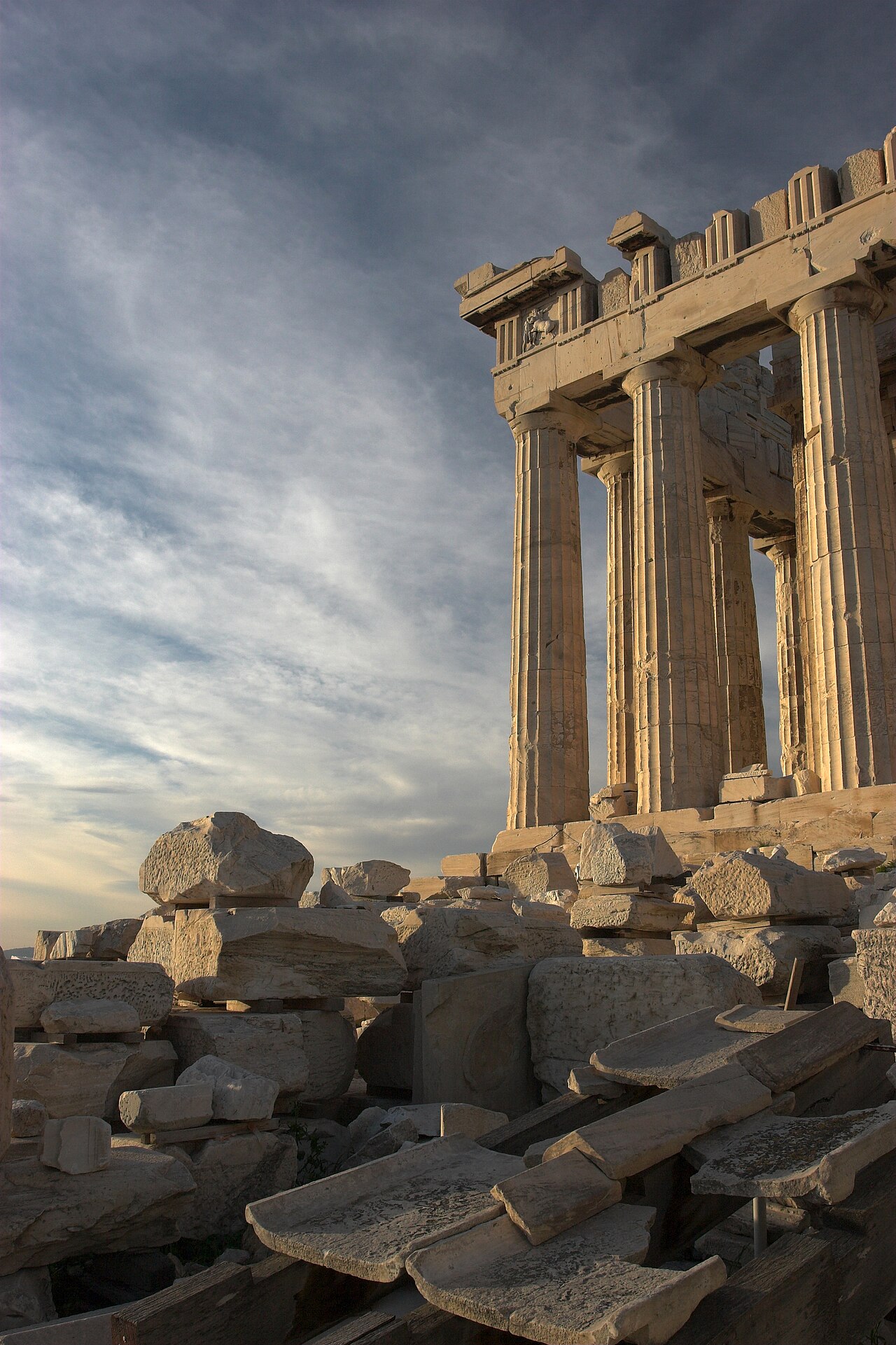
The Parthenon was built between 447 and 432 BCE under the political leadership of Pericles, with the architects Ictinus and Callicrates overseeing construction and the sculptor Pheidias directing the artistic program. It replaced an earlier temple destroyed by the Persians in 480 BCE and served as the centerpiece of Pericles's ambitious rebuilding program for the Acropolis. Its construction consumed the treasury of the Delian League, an alliance of Greek city-states formed to defend against Persia, whose contributions Athens increasingly diverted to its own glorification, causing widespread resentment among allied states.
The Parthenon is a Doric peristyle temple, surrounded on all sides by columns, of extraordinary proportions: 8 columns at each end and 17 along each side, all of pure Pentelic marble from the quarries on Mount Pentelicus. What makes it a supreme achievement of classical architecture is its systematic use of subtle optical corrections. The platform on which it stands curves upward slightly at the center (the stylobate has a curvature of about 60mm over its length) to counteract the visual illusion that makes perfectly flat horizontal surfaces appear to sag. The columns lean inward very slightly and are slightly thicker in the middle (entasis) to avoid appearing concave. Every major horizontal and vertical line in the building incorporates these corrections, thousands of individually calculated adjustments that give the building an almost organic vitality.
Inside stood the great chryselephantine (gold and ivory) statue of Athena Parthenos, created by Pheidias, standing approximately twelve meters tall. The statue no longer exists, but we know it from ancient descriptions and small-scale copies: Athena stood fully armed, with a shield bearing reliefs of the Gigantomachy and the Amazonomachy, a small figure of Nike (Victory) in her right hand, and a coiling serpent at her feet. The exterior of the Parthenon was covered with sculptural decoration of the highest quality: the triangular pediments were filled with mythological scenes, the 92 metopes showed scenes of battle against mythological enemies (Lapiths vs. Centaurs, Gods vs. Giants, Greeks vs. Amazons), and the continuous Ionic frieze running around the interior depicted the Panathenaic procession, showing ordinary Athenian citizens approaching the gods.
The Parthenon's subsequent history is a study in the violence of time and religion. In Late Antiquity it was converted to a Christian church; under Ottoman rule it became a mosque. In 1687, Venetian forces besieging Athens scored a direct artillery hit on the Parthenon, which the Ottomans had been using as a powder magazine. The explosion destroyed the interior and blew out the central columns. Between 1801 and 1812, the British diplomat Lord Elgin removed much of the surviving sculptural decoration, now the "Elgin Marbles" in the British Museum. The Greek government has sought their return for decades, arguing that the sculptures belong to the site and the culture that created them. The Parthenon itself remains standing on the Acropolis, still visible across Athens from the sea, a ruined but unmistakable monument to the classical ideal of perfect proportion.